
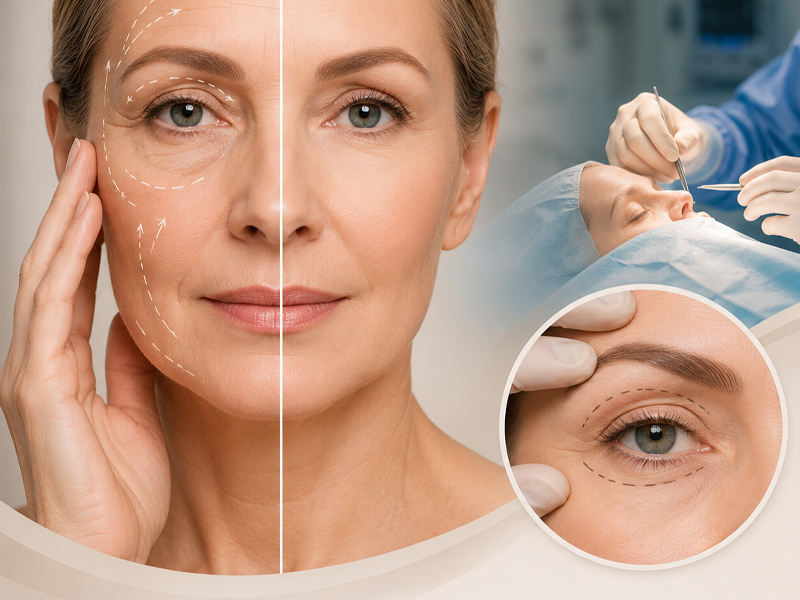
Facial aging affects every individual differently, but two of the earliest and most noticeable signs are sagging facial skin and tired-looking eyes. While a facelift effectively restores youthful contours to the lower face and neck, it does not fully address loose eyelids or under-eye bags. Likewise, eyelid surgery rejuvenates the eyes but cannot correct facial laxity.
For this reason, many patients choose combining facelift with eyelid surgery to achieve balanced, natural, and long-lasting facial rejuvenation. Performing both procedures together creates harmony between the upper and lower face while reducing the need for multiple surgeries and recovery periods.
Today, this combination is one of the most requested facial rejuvenation procedures among patients seeking comprehensive anti-aging solutions.
Why Combine Facelift and Eyelid Surgery?
The face ages as a whole, not as separate parts.
Even after a successful facelift, heavy upper eyelids or puffy lower eyelids may continue to create a tired appearance. Similarly, rejuvenated eyelids alone may not improve sagging cheeks, deep smile lines, or loose neck skin.
Combining both procedures allows the surgeon to treat the entire face in a single surgical plan, producing more harmonious and youthful results.
The goal is not to change your appearance but to restore a refreshed, healthy, and natural-looking version of yourself.
Understanding Facelift Surgery
A facelift, medically known as Rhytidectomy, is designed to reposition facial tissues that have descended with age.
Modern facelift techniques focus on lifting the deeper facial structures rather than simply tightening the skin.
A facelift can improve:
- Sagging cheeks
- Deep nasolabial folds
- Marionette lines
- Loose jawline
- Jowls
- Neck laxity
- Facial definition
Today’s advanced facelift techniques provide subtle, elegant results while maintaining natural facial expressions.
What Is Eyelid Surgery?
Eyelid surgery, also called Blepharoplasty, removes or repositions excess skin, muscle, and fat around the eyes.
This procedure may include:
Upper Eyelid Surgery
Upper blepharoplasty removes loose skin that causes hooded eyelids or a tired appearance.
Benefits include:
- Brighter eyes
- Improved vision (when excess skin obstructs sight)
- Younger appearance
- Better eyelid contour
Lower Eyelid Surgery
Lower blepharoplasty focuses on reducing:
- Eye bags
- Puffy eyelids
- Loose lower eyelid skin
- Under-eye wrinkles
Modern techniques preserve natural anatomy while minimizing visible scars.
Why the Combination Produces Better Results
One of the greatest advantages of combining facelift with eyelid surgery is facial balance.
The eyes naturally attract attention during conversation.
If only the lower face is rejuvenated, aging around the eyes may still dominate the overall appearance.
Likewise, youthful eyelids combined with sagging cheeks may create an unbalanced result.
Treating both areas simultaneously provides comprehensive facial harmony.
Patients often appear:
- Younger
- More energetic
- Better rested
- Naturally refreshed
- More confident
without looking “overdone.”
Benefits of Combining Both Procedures
Patients choosing combined facial rejuvenation enjoy several important advantages.
One Recovery Period
Instead of recovering from two separate surgeries, patients heal only once.
This reduces:
- Time away from work
- Multiple anesthesia sessions
- Additional surgical costs
- Emotional stress
More Natural Facial Harmony
Every facial feature ages together.
By rejuvenating both the eyes and lower face simultaneously, surgeons create consistent improvements across the entire face.
Natural proportions are preserved.
Long-Lasting Results
Modern facelift techniques combined with blepharoplasty often provide results that remain attractive for many years.
Although the aging process continues naturally, patients usually maintain a younger appearance significantly longer than without surgery.
Who Is an Ideal Candidate?
Good candidates generally include healthy adults experiencing visible facial aging.
Patients often seek combined surgery because they notice:
- Drooping cheeks
- Loose neck skin
- Heavy upper eyelids
- Puffy lower eyelids
- Deep facial wrinkles
- Loss of facial definition
Candidates should have realistic expectations and understand that cosmetic surgery enhances appearance but does not stop the natural aging process.
Modern Surgical Techniques
Advancements in facial plastic surgery have transformed facelift procedures dramatically.
Instead of simply tightening the skin, today’s surgeons reposition deeper support structures while preserving facial movement.
Common modern techniques include:
- Deep Plane Facelift
- SMAS Facelift
- Mini Facelift
- Upper Blepharoplasty
- Lower Blepharoplasty
- Fat Repositioning
- Fat Grafting (when appropriate)
These techniques help achieve softer, more natural results with improved longevity.
Preparing for Surgery
Preparation begins with a comprehensive consultation.
During evaluation, the surgeon assesses:
- Skin quality
- Facial anatomy
- Degree of aging
- Medical history
- Previous procedures
- Patient expectations
A personalized surgical plan is then developed to achieve balanced facial rejuvenation.
Recovery After Combining Facelift with Eyelid Surgery
One of the greatest advantages of combining facelift with eyelid surgery is that patients experience only one recovery period. Although healing varies from person to person, most individuals recover smoothly when they follow their surgeon’s post-operative instructions.
Swelling and bruising are most noticeable during the first week and gradually improve over the following weeks. While patients often see immediate improvements after surgery, the final results continue to develop over several months as residual swelling disappears.
Recovery Timeline
First Week
During the first seven days, patients should focus on rest and proper wound care.
Most patients experience:
- Mild to moderate swelling
- Bruising around the eyes and cheeks
- Temporary tightness
- Mild discomfort controlled with medication
Cold compresses, sleeping with the head elevated, and avoiding strenuous activity all contribute to a smoother recovery.
Second Week
By the second week, bruising begins to fade significantly.
Many patients:
- Feel comfortable leaving home
- Return to office work
- Resume light daily activities
- Notice brighter eyes and improved facial contours
Although recovery is progressing well, strenuous exercise should still be avoided.
Weeks Three to Six
Between weeks three and six, facial swelling continues to decrease.
Patients usually notice:
- Better jawline definition
- Smoother neck contour
- Refreshed eyelids
- More youthful facial appearance
- Increased confidence
Most social activities can be resumed during this stage.
Three to Six Months
The face continues to soften naturally.
Scar tissue matures, swelling resolves almost completely, and facial tissues settle into their final position.
Results become increasingly refined every month.
Preparing for Surgery
Excellent results begin with careful preparation.
Before surgery, your surgeon performs a complete facial assessment to determine the most appropriate treatment plan.
Patients are typically advised to:
- Stop smoking several weeks before surgery.
- Avoid blood-thinning medications if medically appropriate.
- Maintain a healthy lifestyle.
- Stay well hydrated.
- Arrange assistance for the first few days after surgery.
- Carefully follow all pre-operative instructions.
Proper preparation reduces complications and promotes faster healing.
Comprehensive Facial Assessment
Every patient has unique facial anatomy.
During consultation, the surgeon evaluates:
- Skin quality
- Facial volume
- Muscle tone
- Neck laxity
- Eyelid position
- Brow position
- Medical history
- Cosmetic goals
This personalised evaluation ensures the surgical plan is tailored to each patient’s needs.
Safety and Possible Risks
Every surgical procedure carries some degree of risk. However, modern facelift and blepharoplasty techniques are considered safe when performed by an experienced facial surgeon.
Possible temporary side effects include:
- Swelling
- Bruising
- Numbness
- Temporary tightness
- Mild asymmetry during healing
Less common complications include infection, bleeding, delayed healing, or visible scarring.
Following your surgeon’s instructions greatly reduces these risks.
Tips for a Faster Recovery
Patients can optimise healing by following several simple recommendations.
Healthy Recovery Habits
- Sleep on your back with your head elevated.
- Drink plenty of water.
- Eat protein-rich meals.
- Avoid smoking.
- Limit alcohol consumption.
- Wear sunscreen daily.
- Protect healing skin from direct sunlight.
- Avoid heavy lifting.
- Attend every follow-up appointment.
Small daily habits play an important role in achieving beautiful long-term results.
Frequently Asked Questions
Is it safe to combine facelift with eyelid surgery?
Yes. For suitable candidates, combining both procedures is safe and allows comprehensive facial rejuvenation during a single operation and recovery period.
How long do the results last?
Results vary between individuals, but many patients enjoy a younger appearance for 10 years or longer. Natural ageing continues, but the improvements achieved through surgery are long-lasting.
Will I have visible scars?
Incisions are carefully placed within natural skin folds, around the ears, and along the hairline whenever possible. As healing progresses, scars usually become discreet and difficult to notice.
When can I return to normal activities?
Light activities can often be resumed after one to two weeks. More strenuous exercise should be delayed until your surgeon confirms it is safe.
Can these procedures be combined with other treatments?
Yes. Depending on individual needs, facelift and eyelid surgery may also be combined with brow lift, neck lift, fat grafting, or skin rejuvenation treatments to achieve even more comprehensive facial enhancement.
Why Choose Dr. Somayeh Moein?
Facial rejuvenation requires both surgical expertise and an artistic understanding of facial balance.
Dr. Somayeh Moein is a board-certified Ear, Nose and Throat (ENT) surgeon in both Iran and Turkey, specialising in facial cosmetic procedures, including facelift, eyelid surgery, rhinoplasty, and comprehensive facial rejuvenation.
She uses advanced surgical techniques to create elegant, natural-looking results that enhance each patient’s unique facial features while preserving natural expression. Every treatment plan is individually designed, with a strong emphasis on patient safety, precision, and long-term satisfaction.
Patients from around the world choose Dr. Somayeh Moein in Istanbul for her personalised care, meticulous attention to detail, and commitment to delivering refined, harmonious, and lasting outcomes.

No comment